


Copyright (c) 1998
Royal Stuarts
All Rights Reserved
Royal Stuarts
All Rights Reserved
|
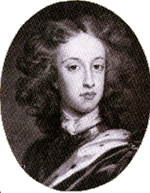
When Gloucester was nine, a separate household was formed of him, and it was another sign of Marlborough's slowly rising fortunes that William appointed him Governor. But is was not a post he was to enjoy for long. Gloucester's eleventh birthday, in July 1700, was celebrated at Windsor with the splendor appropriate for a future king, and after a display o fireworks followed by a great banquet in the castle, the excited boy retired to bed exhausted. The next day, a Friday, he woke with a feer and nausea and complained of a sore throat. The hastily summoned physicians decided they should bleed him in order to lower the fever which, for a few hours, seemed to slacken its hold on the Prince, but only to return more violently than ever in the evening. As his condition deteriorated, Radcliffe, the most eminent doctor of the day, was sent for, but when he heard of the blood-letting he declared to the anxious physicians, 'Then you have destroyed him and you may finish him for I will not prescribe.'
Whether or not it was the bleeding that fatally weakened him, Gloucester was indeed dying. He lived for another four days, constantly delirious, shouting and tossing in his bed, while Anne sat beside him, praying and hoping for a miracle that would save him. But on the following Monday, just before midnight, he died. Anne's composure in face of this terrible blow awed those around her. She did not weep and Prince George could only marvel at the 'pious fortitude of his beloved Princess'. But beneath th calm she was stunned with grief and Gloucester's death which sealed the tragedy of her motherhood, turned Anne into a sad woman, facing the future with little enthusiasm.